How to install a new microwave safely
A Newton homeowner's guide to installing a new microwave safely: outlet checks, bracket mounting, cord routing, and when to call a pro.
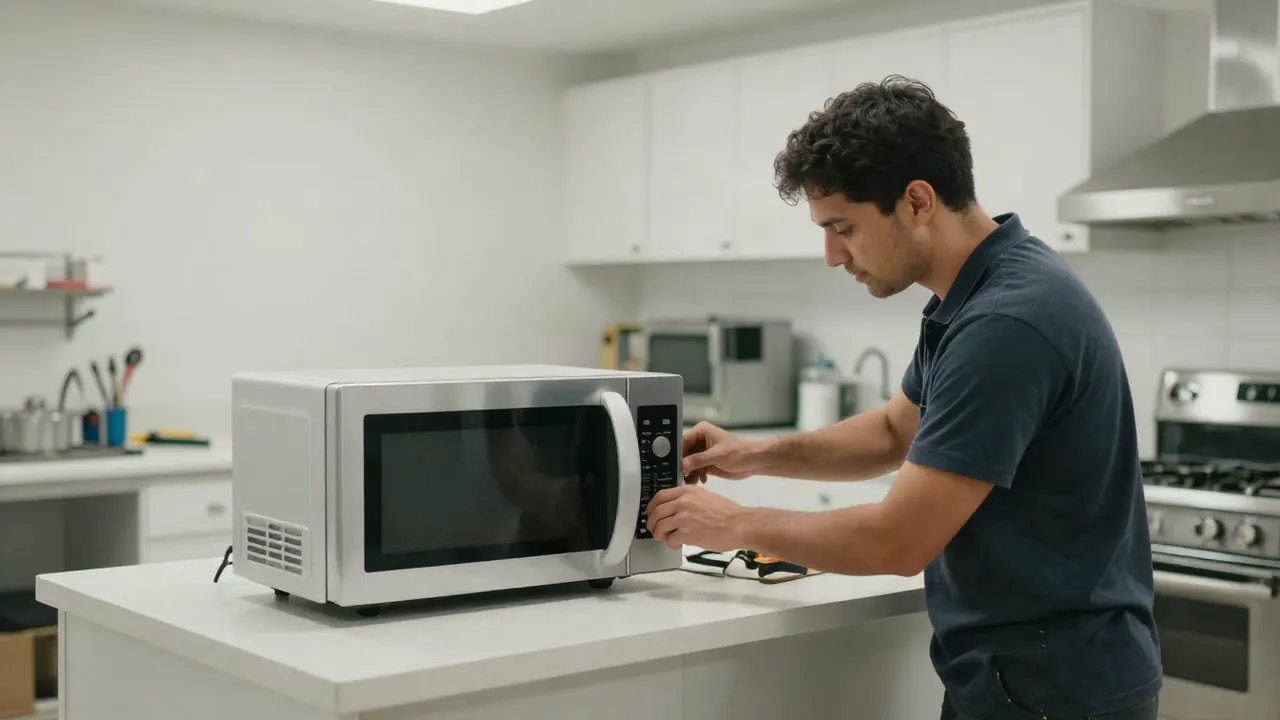
Installing a new microwave safely in Newton MA means three things: the circuit can carry the load, the unit is physically secured so it cannot tip or fall, and the cord is routed so it never sits against a heat source or gets pinched. Get those three right and the rest is straightforward. This guide walks you through the outlet check, the bracket work, the cord routing, and the mistakes we fix most often on microwave calls around Newton.
We are Newton Appliance Repair, and we handle microwave installs and repairs across the city every week. If you would rather skip the ladder work, our team can take care of it. For everything else, here is how to do it right.
Start With the Electrical Reality of Your Kitchen
A microwave draws more current than most people expect. A typical countertop unit pulls 10 to 13 amps, and a larger over-the-range model can pull 14 to 15 amps on a 120-volt circuit. That is why the National Electrical Code (NEC) requires a dedicated 20-amp circuit for most fixed microwave installations, and why you should never share that circuit with a toaster, coffee maker, or electric kettle.
Before you unbox anything, find the breaker panel and confirm the circuit. If the microwave is going over the range, the outlet is usually inside the cabinet above it. If you are replacing an old unit, the circuit is probably already correct. If you are adding a microwave to a counter that never had one, you may need an electrician to run a new line.
Check the outlet itself. A loose receptacle, a scorched faceplate, or a plug that feels warm after a few minutes of use are all signs the circuit is not ready. We see this often in older homes across Appliance Repair in Newton Centre, where kitchens were wired decades before anyone owned a microwave. If the outlet is questionable, stop and get it looked at before you plug in.
One more electrical note: never use an extension cord or a power strip for a microwave. The unit needs a direct, grounded connection. If the cord will not reach, the outlet needs to move, not the cord.
Countertop vs. Over-the-Range: Two Very Different Installs
A countertop microwave is the simpler job. You set it on a flat, heat-resistant surface, leave at least 3 inches of clearance on the sides and back for ventilation, and plug it in. The main safety concerns are stability and cord placement, not mounting hardware.
An over-the-range microwave is a different animal. It hangs from a mounting plate bolted to the wall studs, and it also vents cooking exhaust. That means you are dealing with structural fasteners, a vent transition, and often a recirculating-to-outside vent conversion. If you are not comfortable locating studs and drilling into tile or cabinetry, this is the point where most homeowners call us.
Over-the-range units also weigh more than they look. A 1.6-cubic-foot model can weigh 55 to 70 pounds. You need a second person to lift it onto the bracket, and you need the bracket anchored into at least two studs, not just drywall anchors.
How do I install a new microwave in Newton MA step by step?
Here is the sequence we follow on a standard over-the-range install. Countertop installs skip steps 3 through 6.
- Kill the power. Flip the microwave breaker off and confirm the outlet is dead with a tester.
- Measure the opening. Width, height, and depth. Most over-the-range microwaves are 30 inches wide, but the cabinet cutout and the old unit's footprint matter.
- Locate the studs. Use a stud finder and mark at least two vertical studs behind the mounting plate. If the wall is tile, drill through the tile with a carbide bit before driving the lag bolts.
- Mount the plate. Level it, then drive the lag bolts into the studs. The plate carries the entire weight of the microwave, so this step is not optional.
- Prep the vent. If you are venting outside, attach the transition duct and tape the seams. If you are recirculating, install the charcoal filter and set the blower to the correct orientation.
- Hang the unit. Two people lift the microwave onto the plate, tilt it up, and thread the top bolts through the cabinet above. Do not let go until both top bolts are started.
- Route the cord. The cord goes through the cabinet hole and plugs into the dedicated outlet above. Keep it away from the vent duct and any sharp metal edges.
- Test. Restore power, run the microwave for 60 seconds with a cup of water inside, and check that the turntable spins and the vent fan runs on all speeds.
If you would rather have this done in one visit, our Appliance Installation Services Newton MA cover the full job, including the bracket, vent, and cord routing. We also handle the haul-away of the old unit.
Common Mistakes We See on DIY Microwave Installs
Most microwave install problems trace back to the same handful of shortcuts. Here are the ones we fix most often.
- Mounting into drywall only. A 60-pound microwave will pull drywall anchors out of the wall. It needs studs.
- Ignoring the vent flap. If the outside vent flap is stuck closed, the microwave recirculates grease and moisture back into the kitchen. Check it from outside before you finish the install.
- Pinching the cord. The cord must not run between the microwave and the wall or across the top of the vent duct. Heat and vibration will wear through the insulation.
- Using the wrong circuit. Plugging a microwave into a shared kitchen circuit trips the breaker every time someone runs the toaster.
- Skipping the level check. An unlevel microwave rattles, and the door seal wears unevenly over time.
We also see a lot of installs in older Newton homes where the cabinet above the range was never drilled for a microwave cord. If you are not comfortable drilling through finished cabinetry, that is a job for someone with the right bits and a steady hand.
When to Call a Professional
Call a professional if the circuit is not dedicated, if the wall behind the range is tile or plaster over lath, if the vent needs to be converted from recirculating to outside, or if the microwave weighs more than you and one helper can safely lift. Those are the four situations where DIY installs go wrong most often.
Our team handles microwave installation and repair across Newton, including the neighborhoods where older wiring and plaster walls make the job trickier. If your existing microwave is sparking, humming without heating, or tripping the breaker, that is a repair issue rather than an install issue, and our Microwave Repair Newton MA service covers it. We also work on the rest of the kitchen, from Oven Repair Newton MA to Refrigerator Repair Newton MA, so you can get everything handled in one visit.
Homeowners in the older triple-deckers and capes around Appliance Repair in Newtonville often find that the cabinet above the range was built for a smaller unit than the one they bought. We measure first, then install, so there are no surprises.
Frequently Asked Questions
How do I install a microwave safely in Newton MA?
Confirm the circuit is a dedicated 20-amp line, mount the bracket into at least two wall studs, route the cord away from heat and sharp edges, and test the unit for 60 seconds before regular use. If any of those steps are not possible with your kitchen layout, call a professional installer.
Should I hire a pro to install a microwave in Newton Massachusetts?
Hire a pro if the microwave is over-the-range, if the circuit is shared, or if the wall is tile or plaster. A countertop microwave on a dedicated outlet is a reasonable DIY job. Over-the-range installs involve 55 to 70 pounds of weight and structural fasteners, which is where most DIY mistakes happen.
How much does microwave installation cost in Newton MA?
Typical 2026 pricing in this area runs $120 to $250 for a countertop install and $200 to $400 for an over-the-range install, including the bracket and vent work. If a new dedicated circuit is needed, add $250 to $600 for an electrician. We quote the full job upfront before we start.
Can I install an over-the-range microwave myself in Newton MA?
You can if you can locate and drill into two studs, lift 60-plus pounds with a helper, and handle the vent transition. If the wall is tile, if the cabinet needs modification, or if you are not comfortable on a ladder, hire a pro. The bracket is the part that fails when this goes wrong.
Do I need a dedicated circuit for a microwave in Newton?
Yes, for any fixed microwave installation. The NEC requires a dedicated 20-amp circuit for most over-the-range units. A countertop microwave can sometimes share a circuit, but it will trip the breaker if you run a toaster or kettle at the same time.
Get help with Appliance Repair in Newton
If you want your new microwave installed safely, leveled, and vented correctly the first time, our team can handle it. We install countertop and over-the-range units across Newton, and we check the circuit before we plug anything in.
Call Newton Appliance Repair at (877) 715-0155 to schedule your microwave installation. We will confirm the circuit, mount the unit, route the cord, and test it before we leave.