Why is my ice maker not making ice?
Ice maker not making ice in Newton MA? Here are the seven causes we find most often, what each fix costs in 2026, and when to stop troubleshooting and call us.
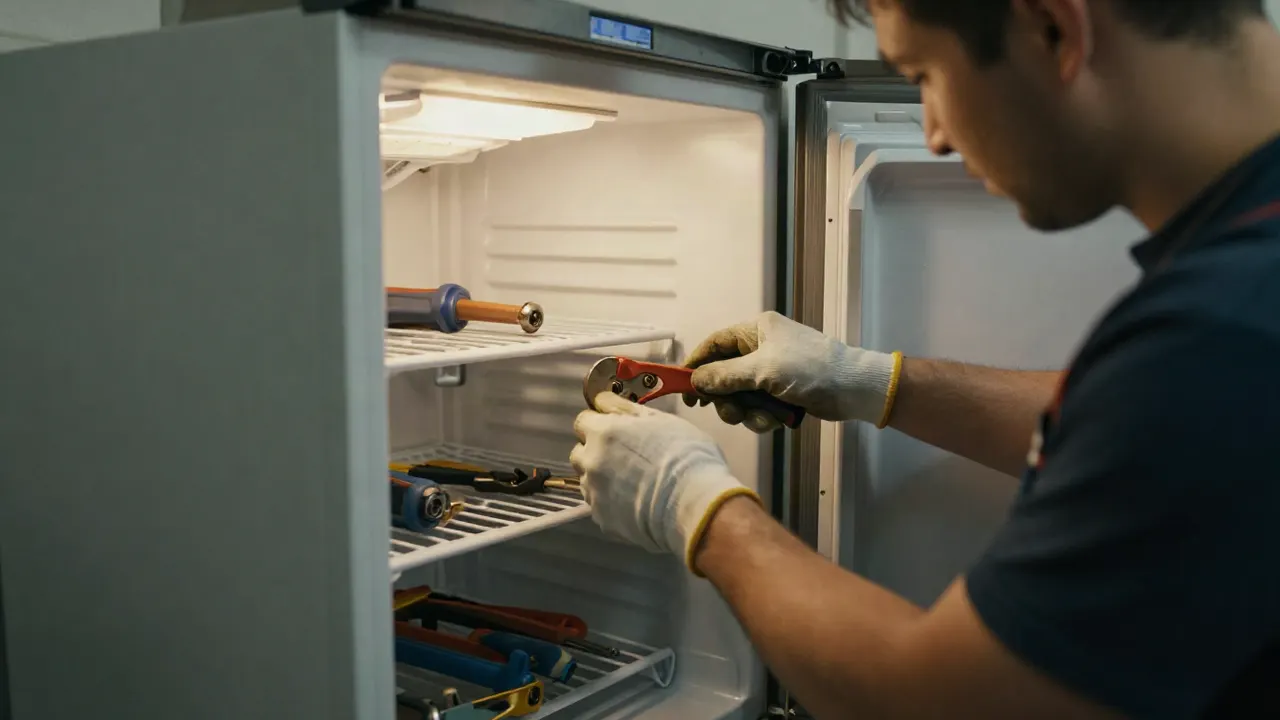
Your ice maker stopped making ice because of one of seven things: a kinked or frozen water supply line, a clogged or frozen fill tube, a failed water inlet valve, a bad ice maker module or thermostat, a water filter that is past due, a freezer running too warm, or a control board that has stopped sending the fill signal. In our experience across Newton, the water line and the inlet valve account for roughly six out of every ten no-ice calls we run. The rest of this post walks through each cause in the order we check them, what a fix costs in 2026, and the point where troubleshooting stops being worth your Saturday.
The short answer: why your ice maker stopped in Newton MA
Why is my ice maker not making ice in Newton MA is really a plumbing question as much as an appliance question, because the ice maker is the only part of your fridge that depends on a live water connection. If water never reaches the mold, no ice forms - no matter how healthy the compressor is.
An ice maker is a small electromechanical assembly inside your freezer that fills a mold with roughly 3 ounces of water, freezes it in 60 to 90 minutes, then pushes the cubes into the bin with a heater-assisted ejector cycle. When any link in that chain breaks - supply, valve, filter, thermostat, or control board - production stops while the freezer keeps running normally. That is why your milk is still cold and your ice bin is empty.
Most no-ice problems fall into two buckets: no water getting in or water getting in but not freezing or ejecting. Figure out which bucket you are in and you have already cut the diagnostic list in half.
Start here: five checks before you call anyone
These five checks take about ten minutes, require no tools beyond a flashlight, and resolve a surprising share of calls before we ever roll a truck.
- Confirm the ice maker is actually switched on. Look for the bail arm (metal arm across the mold) or the on/off wire arm. If the arm is up, the unit is off. On newer models, check the control panel for an "Ice Off" indicator.
- Check the water filter. A filter past its rated life drops flow enough that the mold never fills. Most manufacturers call for a change every 6 months or 200 gallons.
- Look at the fill tube at the back of the freezer. If you see a plug of white ice where the tube enters the mold, you have a frozen fill tube - the single most common cause we see in Newton.
- Pull the fridge out and inspect the supply line. A kink behind the unit or a saddle valve that has been overtightened will starve the ice maker.
- Check the freezer temperature. It should sit between 0°F and 5°F. At 10°F or above, ice forms slowly or not at all, and the ejector cycle can time out.
If those five come back clean, the problem is inside the machine, and that is where our Ice Maker Repair Newton MA team spends most of its time.
The seven real reasons an ice maker stops producing
Here is the list we work through on every no-ice call, roughly in order of how often each one turns out to be the culprit.
1. Frozen or clogged fill tube
Water drips into the mold through a tube at the back of the freezer. If the freezer door has been left ajar, or the fill valve drips slightly after each cycle, that tube freezes solid. You will see a visible ice plug. Thawing it takes 20 to 30 minutes with a hair dryer on low, but the real fix is usually replacing the water inlet valve that caused the drip.
2. Failed water inlet valve
The inlet valve is a solenoid on the back of the fridge that opens for about 7 seconds per fill cycle. Coils burn out, screens clog with sediment, and valves stick closed. This is the second-most-common failure we replace. A new valve runs $40 to $90 in parts, plus labor.
3. Kinked or pinched supply line
When the fridge was last pushed back into place, the 1/4-inch copper or braided line behind it may have kinked. Straighten it and you may be done. If the line is brittle or the saddle valve is corroded, we replace both with a proper braided line and a shutoff valve.
4. Water filter past due
A clogged filter cuts flow to a trickle. The mold fills partway, the cubes come out small and hollow, then production stops entirely. Change the filter, then run 2 to 3 gallons through the dispenser to purge air before expecting ice again.
5. Bad ice maker module or thermostat
The module contains the motor, heater, and thermostat that run the eject cycle. When the thermostat fails, the unit thinks the cubes are not frozen and never ejects. On most Whirlpool, KitchenAid, and Maytag units, we replace the whole module rather than the thermostat alone - it is faster and more reliable.
6. Freezer temperature too warm
If your freezer sits at 10°F or above, ice forms slushy and the ejector stalls. Check for a dirty condenser coil, a failing door gasket, or a defrost system problem. This is also the cause we see most often in older refrigerators where the condenser has not been cleaned in years.
7. Control board failure
The main board sends voltage to the inlet valve and the ice maker module. When it fails, you get no fill and no eject - but the freezer still cools. Board replacement is the most expensive of the seven, and it is the one we confirm with a meter before quoting.
Why is my ice maker not making ice in Newton MA specifically?
Newton's housing stock and water supply create a few patterns we see over and over. Most of the city's homes were built before 1950, and many still have the original 1/4-inch copper ice maker lines running from a saddle valve on a cold-water pipe. Those saddle valves corrode, restrict flow, and eventually leak - we replace several every month.
Newton's water is moderately hard, and that mineral content slowly scales up the inlet valve screen and the fill tube. If you have never had your inlet valve screen cleaned, that is worth doing every few years.
We also see a seasonal pattern. Every spring, as the ground thaws and the city's older pipes shift, we get a run of no-ice calls from homes in Appliance Repair in Newton Centre and the surrounding villages where the supply line has worked loose or the saddle valve has started weeping. If your ice maker stopped right after a cold snap or a thaw, the supply line is the first thing to check.
What ice maker repair costs in Newton MA in 2026
Typical 2026 pricing in this area breaks down like this. These are real ranges we quote, not national averages.
- Diagnostic visit: $79 to $129, waived when you approve the repair.
- Water filter replacement: $45 to $90 installed, depending on the model.
- Fill tube thaw and valve replacement: $180 to $320 all-in.
- Water inlet valve replacement: $200 to $350.
- Ice maker module replacement: $280 to $450.
- Control board replacement: $380 to $650.
- Full ice maker assembly replacement (module plus valve plus line): $450 to $750.
For comparison, a new counter-depth French-door refrigerator runs $1,800 to $3,200 in 2026. Unless your fridge is 15 years old or has a second major failure, repairing the ice maker is almost always the better call. We quote the price before we start, and the diagnostic fee comes off the bill when you approve the work.
Common mistakes we see homeowners make
We get called to fix ice makers that were made worse by a well-intentioned DIY attempt. Here is what to avoid.
- Chipping at the ice plug with a screwdriver. You will puncture the fill tube or the mold liner. Use warm water or a hair dryer on low.
- Forcing the ejector arm. The plastic gears strip easily. If the arm will not move by hand with light pressure, stop.
- Replacing the ice maker module when the real problem is the inlet valve. This is the single most common misdiagnosis. If no water is entering the mold, a new module will not help.
- Turning the freezer colder to "force" ice. Below 0°F, the eject cycle can time out and you will get no ice at all.
- Ignoring a slow drip behind the fridge. A weeping saddle valve can quietly damage flooring for months before you notice.
If you have already replaced a part and the ice maker still will not produce, that is the point to stop. Our Refrigerator Repair Newton MA techs carry the meters and the common valves and modules on the truck, so we usually finish in one visit.
When to call a professional
Call us when the fill tube is not visibly frozen, the filter is fresh, the freezer is at 0°F, and you still have no ice. That combination points to the inlet valve, the module, or the control board - all of which need a multimeter and, on most models, partial disassembly of the freezer compartment.
Also call if you see water on the floor behind or under the fridge. That is a supply-line problem, not an ice maker problem, and it can damage subfloor and cabinetry fast.
We handle ice maker work as part of our broader Appliance Repair Newton MA service, and we cover every village in the city - from the older homes near Appliance Repair in Newtonville to the newer construction out toward Chestnut Hill. Most no-ice calls are diagnosed and repaired in a single visit.
Frequently Asked Questions
Why is my ice maker not making ice in Newton MA?
The most common causes in Newton are a frozen fill tube, a failed water inlet valve, or a supply line restricted by an old saddle valve. Newton's pre-1950 housing stock and moderately hard water make those three failures especially common. Start by checking the fill tube and the filter.
Can I fix an ice maker myself in Newton?
Yes, for the simple cases. Thawing a frozen fill tube, changing the water filter, and straightening a kinked supply line are all reasonable DIY jobs that take under 30 minutes. Anything involving the inlet valve, module, or control board needs a meter and is worth handing to a pro.
How much does ice maker repair cost in Newton MA?
In 2026, most ice maker repairs in Newton run $180 to $450, including parts and labor. Control board replacements push toward $650. The diagnostic fee is $79 to $129 and is waived when you approve the repair.
Should I call appliance repair for ice maker issues in Newton Massachusetts?
Call us if the fill tube is clear, the filter is new, the freezer is at 0°F, and you still have no ice - or if you see water on the floor. Those symptoms point to the valve, module, or board, and we can usually diagnose and fix them in one visit.
How long does ice maker repair take?
Most repairs take 45 to 90 minutes on site. Fill tube thaws and filter changes are the quickest. Module and control board replacements take longer because the freezer compartment has to be partially disassembled, but we still finish the same day.
Get help with Appliance Repair in Newton
If your ice maker has stopped and the simple checks did not bring it back, we can diagnose it and give you a straight answer on whether it is worth fixing. We work across every Newton village and stock the common valves and modules on the truck.
Call Newton Appliance Repair at (877) 715-0155 to schedule a visit.